Six weeks ago we opened the Hirebase closed beta and started watching real teams put AI coworkers on real work. We went in with a list of features we expected to build next. The beta cohort crossed most of them out and wrote something better in the margin.
This post covers what they taught us, what shipped this week because of it, what the work costs to run now, and what happens next.
What the beta actually told us
Here is the request we expected: “make the transcription better,” “make the summary shorter,” “add another integration.” One-tool optimizations.
The request we actually got, phrased in a dozen different ways: why am I still doing everything around the meeting?
One operations lead in the cohort walked us through her Tuesday. Before the 10:00 customer call she spent twenty minutes pulling context: last emails, CRM history, the open items from the previous call. During the call she took notes badly because she was also running it. After the call she spent another half hour turning the notes into tasks, writing the follow-up email, and updating the CRM. The meeting was thirty minutes. The meeting’s gravity was an hour and a half.
She didn’t want a better transcript. Nobody in the cohort wanted a better transcript. A transcript is a tool, and teams already have a drawer full of tools, each one handling a single slice and handing the rest back to a human. What they needed was a coworker: someone who shows up prepared, pays attention, and then goes and does the actions the meeting created, without being told twice.
That reframe — sequence over tools — reframed the entire release.
What shipped this week
The first major closed beta update ships the meeting sequence end to end. Four pieces, designed as one motion:
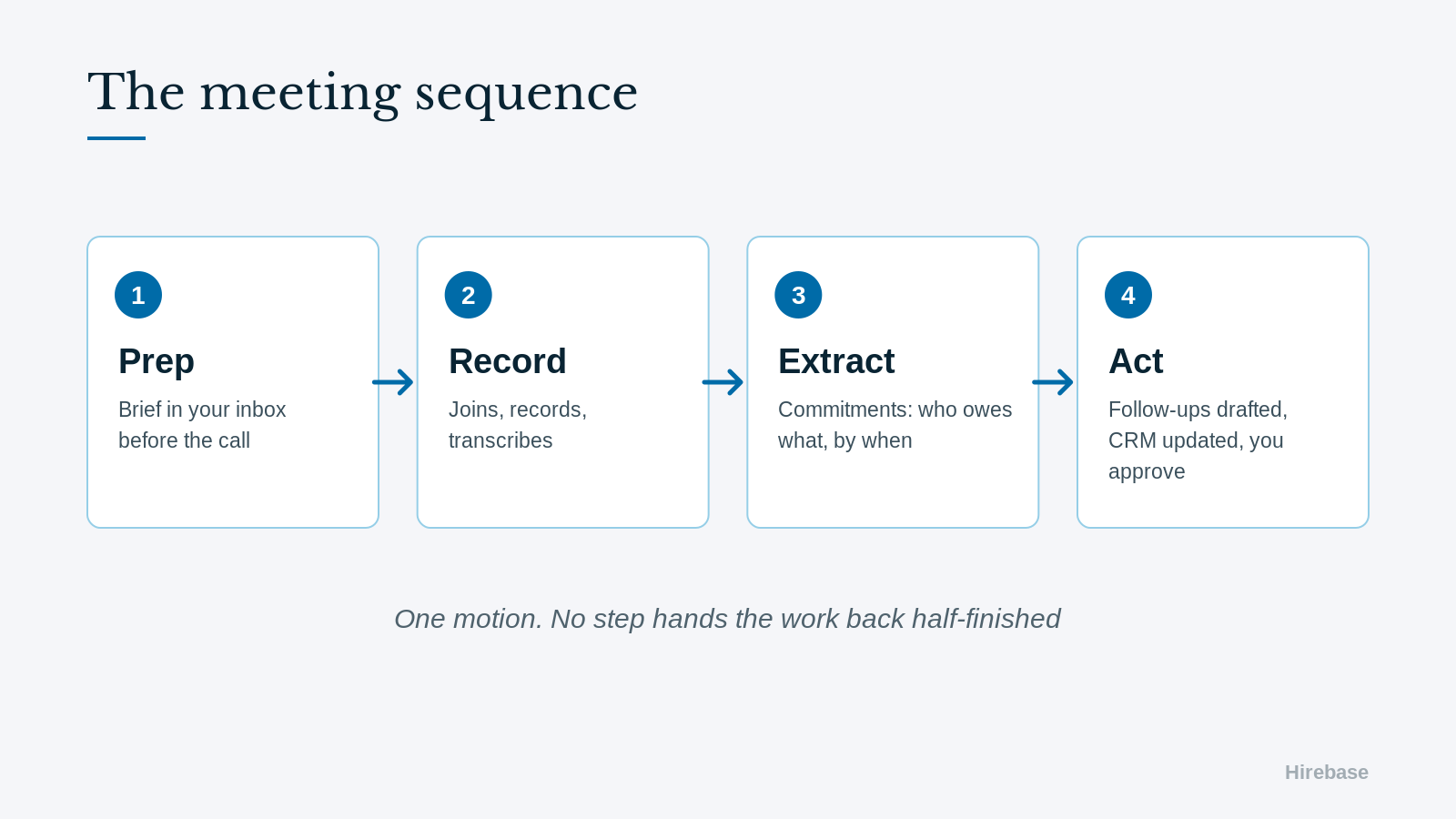 The meeting sequence: prep → record → extract → act
1. Meeting prep. Before the call, your AI coworker assembles the brief: who you’re meeting, the email history, the CRM record, what was promised last time, and what’s still open. It lands in your inbox before you’d have thought to start digging. The twenty minutes of context-pulling becomes a read-through.
2. Recording and transcription. The coworker joins the call from the calendar, records it, and produces a clean transcript and summary. You run the meeting; it takes the notes.
3. Action item extraction. This is usually where tools stop and the human picks the work back up. Instead, the coworker reads the meeting for commitments, who owes what to whom, by when, and turns them into a structured list you review, not a wall of text you mine.
4. Automatic follow-ups. The follow-up email is drafted and ready, the CRM is updated, the agreed next steps are scheduled. You review and approve; nothing goes out without you. But the work the meeting created is done before the next meeting starts.
Each piece is useful alone. The point is that no piece hands the work back to you half-finished. Prep flows into the call, the call flows into the action items, the action items flow into the follow-ups. That is the difference between a tool and a coworker, and it is the thing the beta cohort asked for almost unanimously.
What it costs to run, and why
Now the part that makes the entire sequence economically boring to run — and in infrastructure, boring is the highest compliment there is.
A full meeting sequence is heavy: prep research across email and CRM, transcription of a 30–60 minute call, extraction over the full transcript, drafting follow-ups with context. Run every step of that on a single frontier model and the model usage adds up fast — the kind of line item that makes a CFO ask why the notetaker bills like a consultant.
Hirebase doesn’t run it that way. Each step routes to the most efficient model that does the job well: transcription and extraction are routine work for fast, cheap open models; prep synthesis and follow-up drafting go to stronger open models only where the thinking earns it. Routed across open weights served on our own infrastructure, the same sequence costs roughly a tenth as much to run — an order of magnitude cheaper, about 10× less than a single frontier model, in line with the 6–30× gap we’ve measured across other jobs, with output a reviewer would struggle to tell apart.
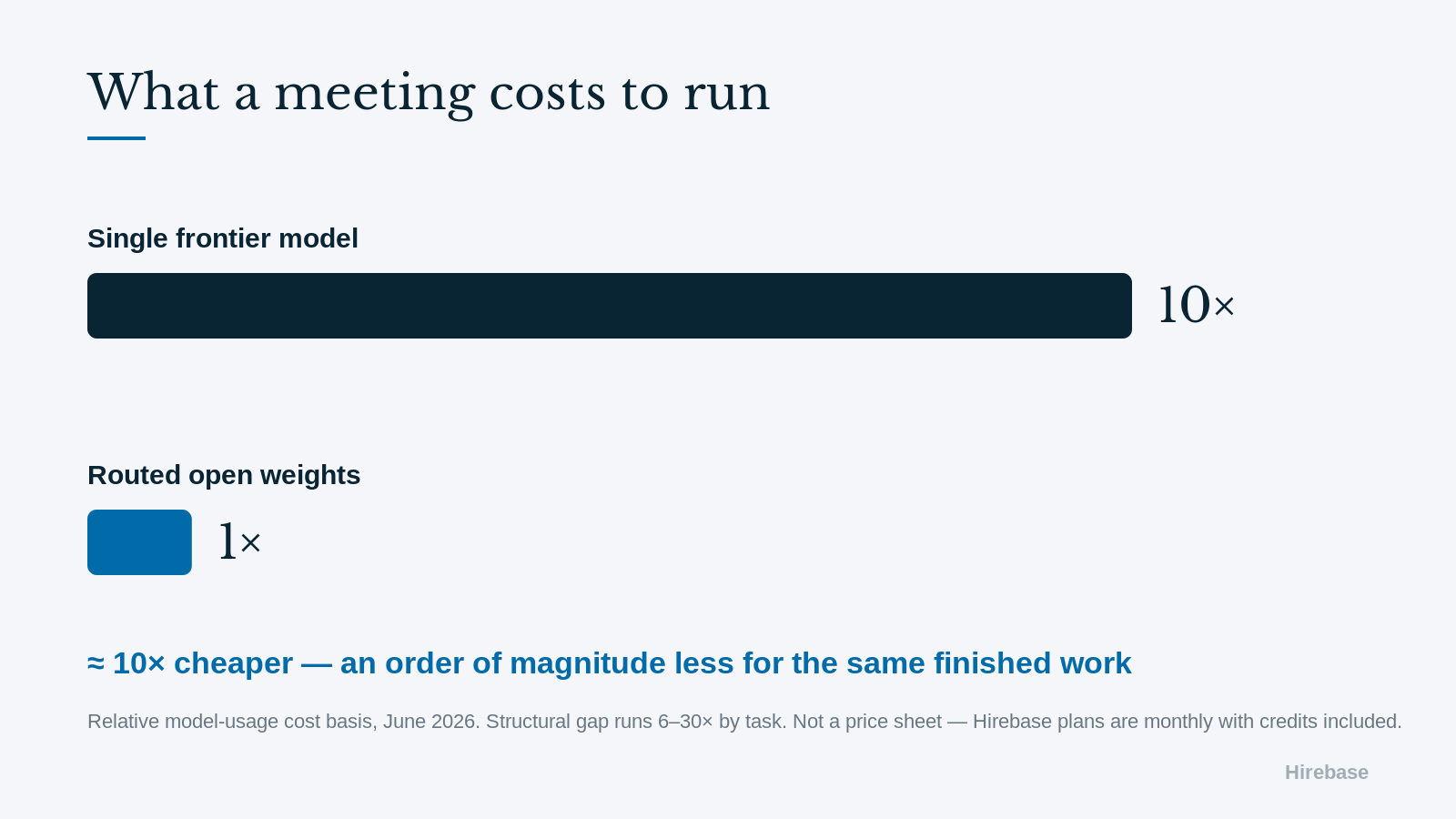 The same meeting sequence runs about 10× cheaper routed across open weights than on a single frontier model
Two things to be straight about. The comparison is a cost basis, the underlying model usage costs to run, not a price sheet; your plan stays a simple monthly subscription with credits included and a balance you can always see, no surprise token bill at month-end. And the routing is not a discount lever we pull, it is the operating model. But we don’t sell “cheaper models.” We sell routing — the right model for each step, most of them open weights we serve ourselves. Cheaper is a feature that emerges from doing this correctly.
It also answers the obvious question about your data. Your meeting recordings, your transcripts, your CRM context — all of it runs on infrastructure we control. Nothing ships off to a frontier lab. Nothing feeds anyone’s training run.
On June 12, a government directive forced Anthropic to switch off its two newest models for every customer overnight. The lesson was simple: when your work depends on a single closed model, it depends on that model staying available, and that isn’t always up to the vendor.
A Hirebase coworker isn’t built that way. It doesn’t route to one model, and the models it does route to run on our own infrastructure. So the morning a headline like that lands, the meeting still gets prepped and the follow-ups still go out.
In a month when teams are re-reading their AI vendors’ terms, and watching access disappear without warning, that’s worth saying plainly.
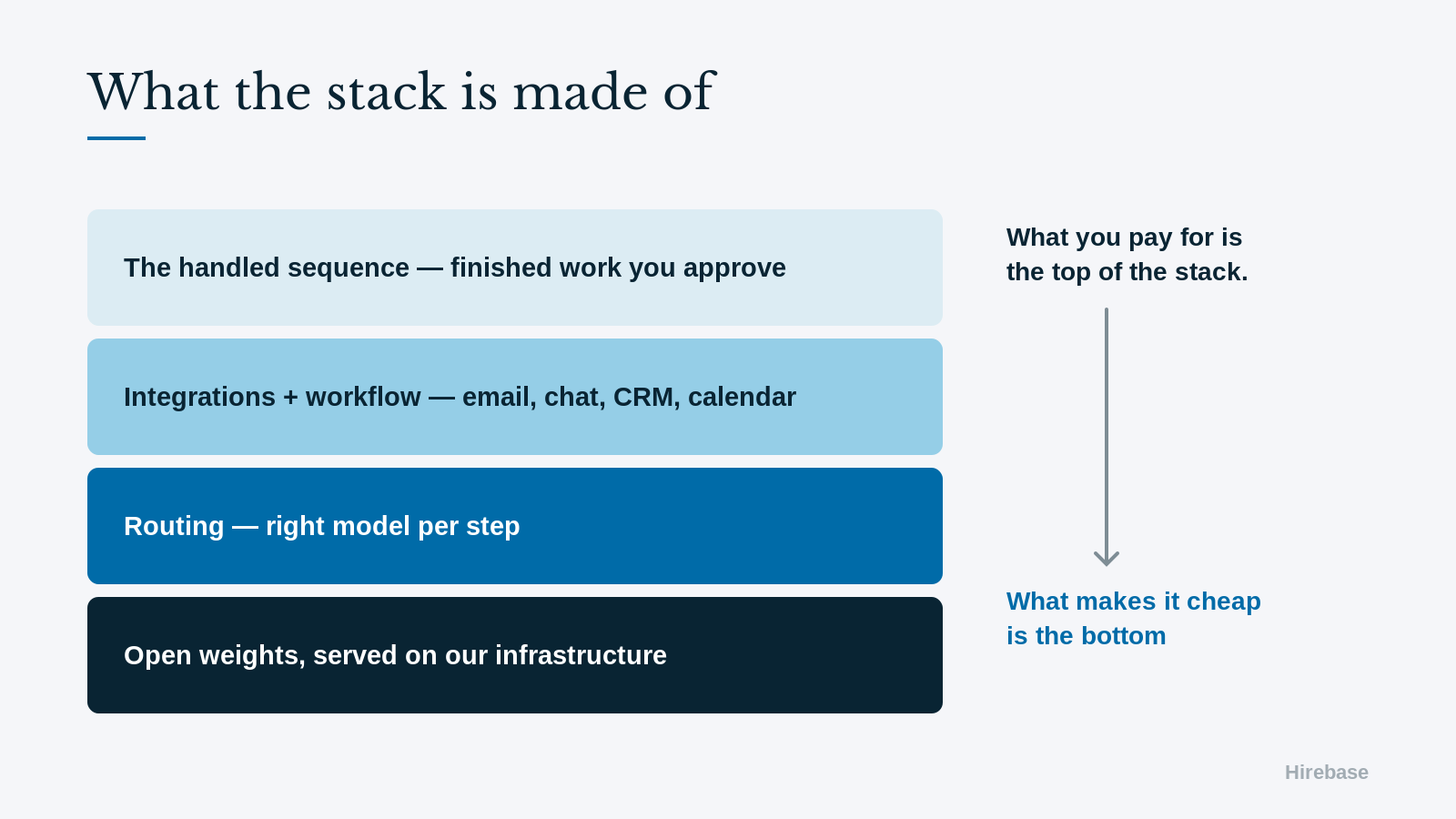 What you pay for: the value stack from raw transcript to handled sequence
What the sequence is really for
A note on what this update is not. It is not a way to send fewer humans to meetings, and it is not a step toward replacing the person who used to write the follow-ups. The operations lead from the beta didn’t get replaced by the meeting sequence; she got her hour back, ten times a week. The judgment in the call, what to promise, what to push on, when to walk, was always the human part, and it still is. The coworker takes the gravity well: the prep, the notes, the extraction, the chase.
That’s the standing thesis here. AI coworkers augment the team you already have. The work they absorb is the work that was stealing hours from the people you hired for their judgment.
What happens next
The beta cohort keeps shaping the order of operations. The same sequence logic — prep, attend, extract, act — generalizes beyond meetings, and inbox and CRM workflows in the current build already share its bones. We’ll publish what ships as it ships, with the same cost arithmetic attached.
The next closed beta cohort opens in early July. If your team’s meetings come with an hour of gravity attached, join the waitlist at hirebase.co and we’ll save you a spot in line. Pricing is transparent and fair, credits included, a balance you can always see, and no surprise token bill at the end of the month.
Hirebase is a product of BasedAI, the acceleration and commercialization layer for open source AI. Enterprise versions of Hirebase are coming soon.